


When Back Pain Changes Motherhood: Living With Degenerative Disc Disease as a Mom
- May 16
- 11 min read
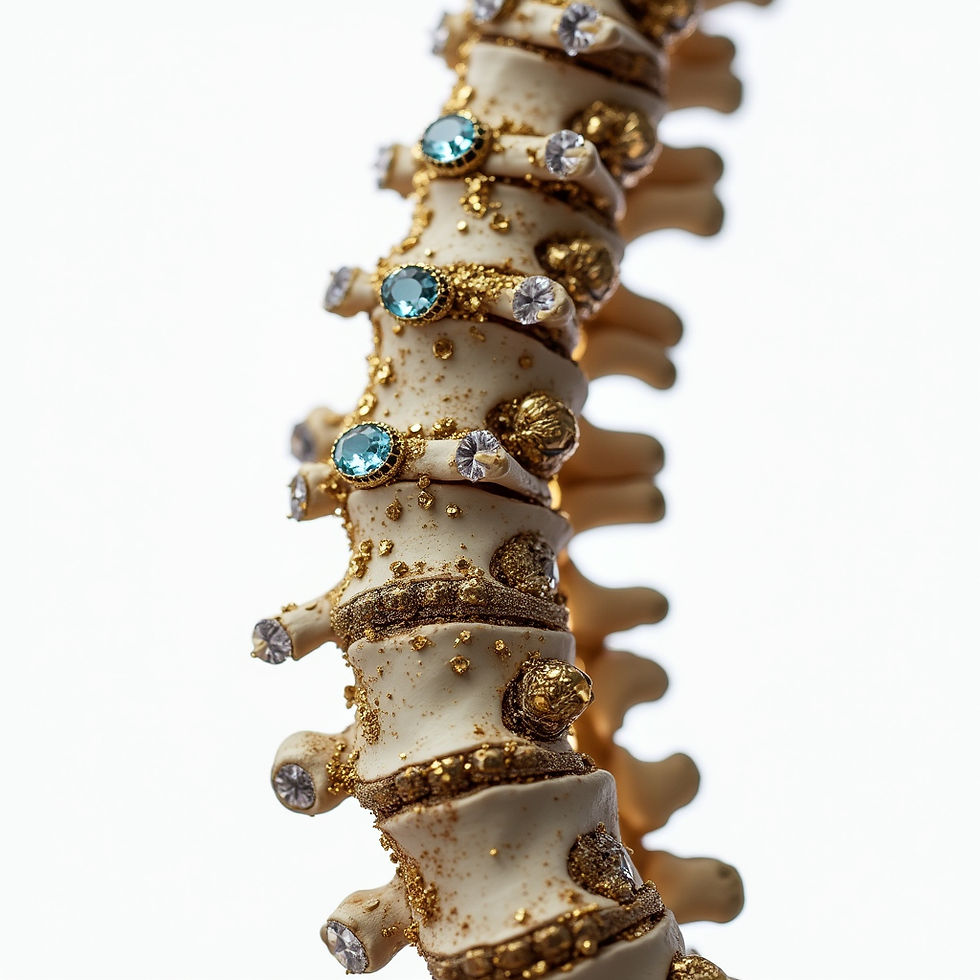
My fear reached far beyond pain. It reached into motherhood, safety, and the fragile life I was trying to build after abuse.
I had young children. I also had an abusive ex-husband, which meant my children depended on me to be the steady, healthy parent. The safe one. The one who could stay regulated, keep the house moving, and protect their softness.
Motherhood asks so much of the body. It's physical in a thousand small ways before the day has even had the decency to begin.
When your back is injured, the physical nature of motherhood takes on new meaning and challenges.
You start measuring every movement before you make it. Picking up your child becomes a risk assessment. Sitting through an appointment has consequences. Dinner after a long drive feels like a physical debt coming due. Even getting down on the floor carries the quiet question of whether you will be able to get back up without pain taking over the room.
That's what scared me most about degenerative disc disease. It threatened my sense of freedom inside my own life. It made me afraid I would lose access to the kind of mother I wanted to be: present, playful, protective, and fully available to the children who needed me.
When Motherhood Pushed My Pain to the Back Burner
Motherhood can quietly teach you to disappear from your own list.
The day fills with needs before you have a chance to notice your own body. Someone always needs to be buckled in, fed, held, or guided through the next small crisis of childhood. And then there was the deeper pressure I was living under.
Because of my abusive ex-husband, I had an enormous responsibility to remain my children’s rock. So my back pain became something I kept postponing.
I treated it like a problem for some later version of my life. I would deal with it when the boys were older and life settled down. When I had more time, more space, more help. When Emmett did not need my body quite so much.
I told myself the pain was just part of motherhood. Mothers are trained to call exhaustion devotion. We learn to fold ourselves around everyone else’s need. Pain can start to feel like one more thing to carry in the laundry basket, one more ache under the noise of the day.
But pain has its own memory.
It waits inside the ordinary motions. It gathers interest. It turns small tasks into negotiations and familiar routines into obstacle courses. Eventually, the life you are trying so hard to hold together begins asking more from your body than your body can give.
I wish I had understood sooner that taking my pain seriously was part of taking care of my children.
They did not need a mother performing wellness while quietly falling apart.
They needed me cared for and present inside my own life.
And I needed that too.
Living With Degenerative Disc Disease as a Mom
One of the hardest parts of degenerative disc disease was how much it changed the small, ordinary rituals of motherhood. I couldn't even get down on the ground and play with my kids. The floor became another country, one I could visit only if I had a painful exit strategy. It killed me.
All I wanted was to cuddle my son. I wanted his head on my shoulder, his body heavy against me, that sacred weight of a child who still believes your arms are the safest place in the world. Pain robbed me of those moments.
Even sitting with the boys on my lap became difficult. That is the kind of intimacy many parents get to take for granted. A child climbs up, settles in, and the body simply makes room. But my body could not always make room anymore.
So I found another way.
When Emmett wanted to read with me, I would sit in a chair and have him stand between my legs. Then I could wrap my arms around him from behind while we looked at the book together. It was not the classic picture of a child curled in his mother’s lap, but it still gave him my arms. It still gave us closeness.
I also had to stop picking up my three-year-old son.
He was still so little and naturally wanted to be held. But I could not put that kind of strain on my back anymore. I felt shame and grief that I could not pick him up like other moms. So I adapted. When he wanted to be held, I would bend down and hug him instead. I gave him warmth and tenderness from where I was. I could not always lift him, but I could still make sure he felt loved.
Now that I am doing better, I pick him up here and there while still being careful. It's such an invaluable joy to feel him melt into my arms, rest his head on my shoulder, and lean into my chest.
That kind of moment feels different after you have lost access to it.
It feels sacred.
Bedtime became one of the hardest parts of the day.
Emmett’s bed was low to the ground, and he wanted me beside him. He wanted the ordinary sweetness of a mother lying next to him while sleep came. I wanted that, too. I wanted to curl into the little world of his bed, feel his body settle, and let the room soften around us.
But getting into that low position hurt. The angle was awkward. The bed was small. My combination of degenerative disc disease and tendinopathy made it painful to fold myself into the shape bedtime required. Even worse, once I got down, getting back up could feel like a battle.
I brought a chair into the bedroom and let the ritual change around my body. From there, I could sit close enough to hold his hand while sleep gathered in the room. The shape of motherhood had changed, but the promise stayed the same: I was near. I was steady. Love had found a form my back could survive.
A Child's Confusion. A Mother's Pain.
Naturally, Emmett, my youngest, had a harder time understanding my chronic pain than my eldest. He was too young to fully grasp why his mother’s body had become unreliable. He knew only that something between us had changed. He missed being held in my arms. I could see it. That missing lived in his little face, in the way he wanted closeness my body kept refusing.
I had to explain that my body had limits other mothers’ bodies might not have, while reassuring them that those limits had nothing to do with my love.
That was a hard balance to hold.
I had to be honest enough that they understood why I could not always lift, chase, crouch, or carry. At the same time, I had to protect them from feeling responsible for my pain. I wanted them to know my body had limits without believing my love did.
My eldest was old enough to understand more. He became helpful in ways that touched me and broke my heart at the same time. He would help me vacuum and pick things up so I did not have to keep bending over. I was grateful for his tenderness, but there is a particular ache in needing your child to accommodate your body.
Pride and guilt can live in the same room.
When Mummy Munster Had to Disappear
Before the pain became so severe, the boys and I had a game called Mummy Munster.
I would playfully wrestle with the, becoming this silly, growling, laughing creature in their little world. It was physical and ridiculous and full of joy.
For a while, Mummy Munster had to disappear.
My body could not handle the chasing, the sudden movement, the twisting, the floor. Pain took that playful version of me and pushed her behind glass. But my boys adapted too.
I could still wrestle and tickle, but they had to come to me. They knew I could not chase them around, so they made it easier for me to grab them. They would come close enough to be caught. They let the game change shape so I could still be part of it.
That detail still makes me emotional.
Children can be so generous when they love you. They do not always understand the full story, but they understand closeness. They understand, in their own wordless way, how to meet you where you are.
Still, I grieved what pain had taken.
Chronic pain does not only steal movement. It steals the unplanned yes. The sudden scoop. The easy cuddle. The chase down the hallway. The confidence that your body will be there when your child reaches for you.
The Shame of Being Judged for Pain No One Could See
Because chronic pain is so often invisible, other people did not always understand what was happening. They saw a mother who did not pick up her child. They did not see the math happening inside my body: the lift, the twist, the hours of pain that might come after.
I compared myself to other mothers constantly.
I watched women lift their children without hesitation, swing them onto a hip, carry them through parking lots, scoop them up when they cried. Their bodies seemed to move through motherhood with an ease mine had lost. Beside them, I felt exposed: a mother full of love, trapped behind a limit my children never asked for.
The pain was hard enough inside my own body. Judgment made it lonelier.
On outings with my sister Leslie, she often stood in for me and held Emmett when I could not. Sometimes I was grateful for the practical help. But emotionally, it hurt every time. Watching someone else lift my child into their arms felt like watching another person step into a place I desperately wanted to occupy.
In contrast to my sister Leslie, my other sister Sarah shamed me because I could not lift Emmett. She picked him up, but not in a supportive way. It felt like a demonstration. As if she were showing me what a real mother would do. As if I were lazy, careless, or unwilling.
At that point, I did not have the formal diagnosis yet. I only knew that my pain was real and that motherhood had become physically harder than I knew how to explain.
I said nothing.
I went quiet. I felt embarrassed in public. The shame moved through me faster than words could. I had already been comparing myself to other mothers, already afraid my children were missing out, already wondering if my body had made me less than what they deserved.
Sarah’s judgment landed directly on that wound.
Our relationship was already strained. She had rarely been understanding toward me or truly helpful. During the emotional abuse I endured from my husband, she was not there for me either. Some people let you down in more than one season of your life. We are no longer in contact.
That moment became part of a larger truth I was beginning to understand: invisible pain often gets treated like a character flaw.
If people cannot see the injury, they may invent a moral explanation. They may decide you are weak, dramatic, cold, lazy, selfish, or uncaring. For mothers, that judgment can cut especially deep because so much of motherhood is measured from the outside by what people think we should be able to do.
But no one else was living inside my spine. No one else had to pay the price after the outing was over.
My Breaking Point
I ended up in the orthopedic surgeon's office because something felt horribly wrong. The pain had moved beyond the private bargain I kept making with myself.
I was worried about my ability to tend to my children’s daily needs, work and the basic functioning of my life. That was the moment I knew I needed answers.
The diagnosis was frightening. Degenerative disc disease was not what I was prepared to hear. The phrase sounded heavy, permanent, almost like a door closing. But it also gave shape to what I had been living with. Finally, my pain had a name.
After that, getting better became the center of my life.
I was not going to let anything come between me and my children.
No diagnosis, no pain, and no lack of support was going to become a wall between me and my children.
There is nothing in this world that will keep me from caring for them.
Getting Better Was for Them Too
When treatment began, my life filled with appointments.
Doctors. Physical therapy. Acupuncture. The slow, often unglamorous work of trying to help a body recover.
Because I had primary custody 70 percent of the time, I sometimes asked my ex-husband to watch the boys for 45 minutes or an hour so I could attend appointments. Instead of empathy, he responded with anger. He asked for payback. Watching his own children briefly while I tried to care for my body was treated like an unreasonable burden.
Even healing required negotiation with someone who had already made survival harder.
That lack of goodwill hurt, but it clarified something too. I could not wait for other people to understand the seriousness of my pain before I took it seriously myself. I could not build my recovery around the hope that everyone would suddenly become compassionate, helpful, or fair.
I had to act because my children needed me, and because I needed myself back too.
I believe the emotional abuse I endured made healing harder. My body had lived under so much stress, fear, vigilance, and depletion. It is difficult to repair inside a life that keeps reopening the wound. Even after leaving, there were still logistical battles, custody demands, and the emotional residue of being unsupported when support should have been basic.
But my children gave me a reason to keep going.
I was not chasing some abstract version of “better.” I wanted my body back for the small places motherhood actually happens: the edge of a bed at night, the reach across a car seat, the ordinary errands that should not feel like endurance tests. I wanted to play Mummy Monster again, even if I had to move differently. I wanted to lift Emmett with care and still feel that warm, trusting collapse of his body into mine. Most of all, I wanted pain to stop taking my patience before the day had even begun, so I could build a home that felt soft and full of love.
I had to reassure my children that I would get better even when I did not know if that was true. That was one of the hardest parts: offering comfort while carrying fear.
I put on a brave face because they needed one. I spoke with confidence I had not fully earned yet. I told them I was working on getting better because I wanted them to feel safe, not responsible for my pain.
Motherhood had made me postpone care.
Motherhood also gave me the reason to fight for it.
What I Wish Other Mothers Knew
If you are a mother living with chronic back pain, I want you to hear this before you wait as long as I did:
Your pain matters.
It matters before it becomes a crisis and you lose the ability to do the things that make you feel like yourself. You do not have to earn care by breaking down completely.
For so long, I thought taking care of my back would somehow take something away from my children. Time. Attention. Energy. Money. Focus. But ignoring my body was already taking something from us. It was taking ease. Play. Patience. Freedom. The small, physical rituals that make family life feel warm and alive.
Taking care of my back became one of the ways I took care of my children.
They needed me present, yes. They also needed me supported, functioning, and able to keep living inside the life we were building together.
Mothers are often praised for self-sacrifice, but our bodies are where our children meet us. They are how we hold hands at bedtime, carry groceries, drive to appointments, read books, cook dinner, wipe tears, offer hugs, and sit beside the people we love.
Our bodies are not disposable.
Neither is our pain.
Now, when I am able to pick up Emmett here and there, I do it carefully. I listen to my body. I do not take the moment lightly. Feeling him rest his head on my shoulder, feeling his weight lean into my chest, feeling that old closeness return even briefly — it feels sacred in a way it never did before.
Because I know what it is to lose access to something that once seemed ordinary.
I know what it is to love your children with your whole heart while your body refuses to cooperate.
And I know this now, too: Caring for myself was never separate from caring for my children.
It was part of how I stayed.


