

How Emotional Abuse Trapped My Body in Chronic Pain
- May 4
- 11 min read
Updated: May 19

How Emotional Abuse Can Show Up as Chronic Pain
For years, I thought my body was failing me.
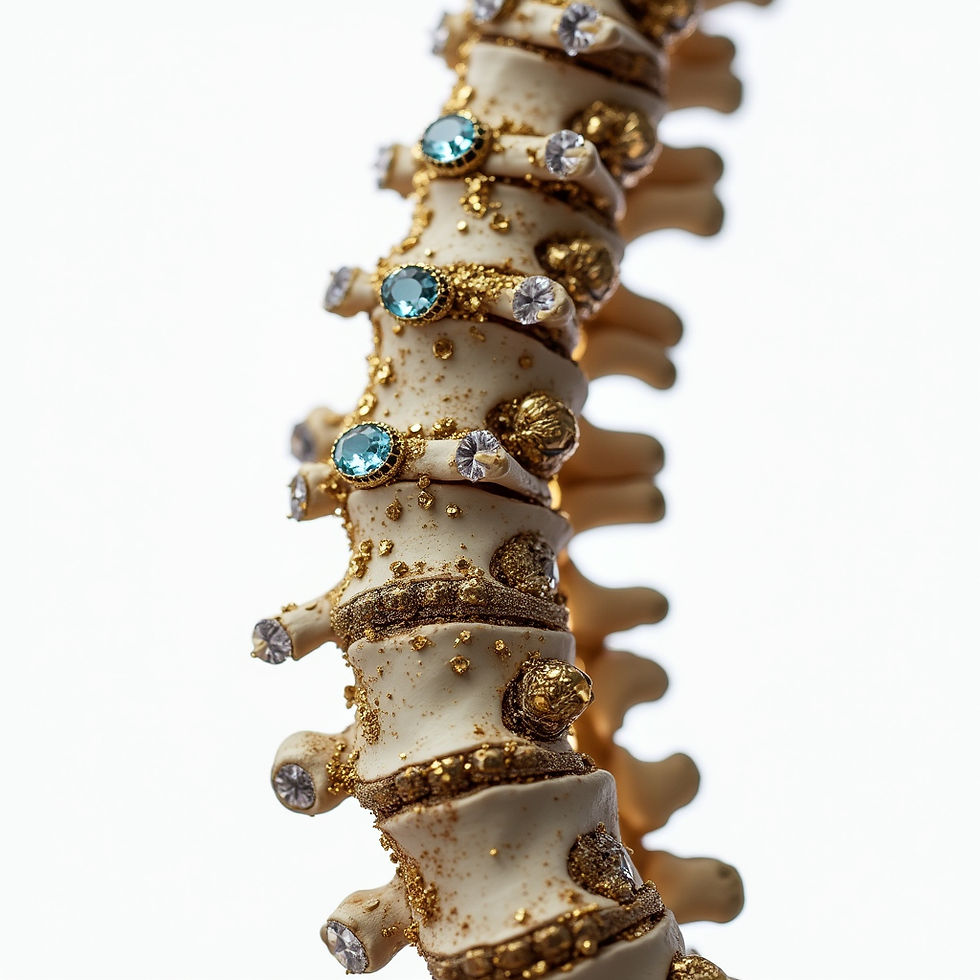
My lower back ached constantly. The pain sank into my hips and butt like a deep, stubborn bruise that never had time to heal. My jaw stayed clenched as if I were holding back words even in my sleep. I ground my teeth at night until my mouth carried its own private evidence of stress.
I searched everywhere for answers. I looked at posture, inflammation, hormones, aging, pregnancy, breastfeeding, physical therapy, supplements, sleep, movement, and every possible mechanical explanation. I wanted the pain to fit inside something clean and solvable. A diagnosis. A treatment plan. A reason that made sense.
Eventually, I did receive real diagnoses. My spine was not imaginary. My pain was not invented. My body had discs, joints, tendons, muscles, nerves, and structural problems that deserved medical care.
But I understand something now that I could not see then.
My body was not breaking down in isolation.
It was trying to survive the life I was living.
The pain flared after intimidation, sleep deprivation, and tension in the house. It rose in the aftermath of yelling, cussing, accusations, contempt, and the steady emotional warfare of living with someone unpredictable. My nervous system felt like a live wire because my home was wired with danger.
I wanted my body to relax inside a life that kept teaching it to brace.
That is a brutal place to heal from.
The House Where My Body Learned Fear
There are houses where a person can exhale. Mine was not one of them.
My ex-husband had a way of filling the air with contempt. He was the "king" of the shitty remark and possessed a sharp tongue that cut deep into my softest places... the kind of man who could turn an ordinary room into a courtroom and make every need sound like an offense against him.
He followed me from room to room, saying abusive things, making accusations, dragging me into long, exhausting monologues about how I had wronged him by not giving in to his needs. If I locked myself in the bedroom to get away from him, he crawled in through the laundry chute.
That image still says everything.
A locked door was not enough. My need for space was treated like defiance. Privacy became something he could invade if he felt entitled to my attention, my body, or my compliance.
He expected me to work full time, primarily care for the kids, cook dinner, manage the house, give him sex, absorb his moods, and remain grateful enough not to question the arrangement. If I pushed back, he yelled. He cussed. He rushed at me as though he might hit me. He threw objects near me and the children.
My body learned to read the room before my mind had formed the thought.
My body learned his weather. A shift in tone moved into my hips. Footsteps changed my breathing. One look could lock my jaw before I had time to think.
Silence was not peace either. Sometimes silence was the pause before the next attack.
I lived in constant fear for my children. I did not trust him around them. That fear did not stay abstract.
My body became a house within the house, and every room inside me was listening for danger.
The Postpartum Body Under Threat
There is a particular tenderness to the body after a C-section.
You have been opened. Your abdomen aches. Your core feels foreign. Every movement becomes a negotiation with pain. Sitting up, lying down, lifting the baby, reaching for a burp cloth, shifting a newborn from one breast to the other, lowering yourself into bed without pulling at the incision. Ordinary motions become small acts of endurance.
My second C-section took longer to heal than my first. The surgery pain was sharp and immediate, its own distinct kind of suffering. But what made recovery so much harder was the absence of care.
I could not get my ex-husband to give me real breaks. He would hold the baby for maybe thirty minutes, then invent a reason to leave. He needed to go to the bathroom. He had something else to do. He would disappear and simply never come back.
Sometimes he left for hours, leaving me with both children while I was still healing, breastfeeding, sleep-deprived, and barely holding myself together.
He went out to play shows with his band while I was home recovering from major surgery and caring for our children. If I questioned why he was not helping more, he shamed me for it.
The message was clear: his freedom mattered. My recovery did not.
One memory from that time still sits in me like a stone.
I was lying in bed breastfeeding Emmett, our youngest, after hours of nursing and rocking him. My C-section pain was intense. I had finally gotten him close to sleep. In the other room, my ex had taken over bedtime with our older son, River.
Then I heard the yelling.
River was struggling to go to bed, as young children sometimes do. My ex expected complete obedience from him, as if a child’s resistance to bedtime were a personal insult. When River did not comply, my ex became vindictive and cruel. I could hear him screaming. I could hear the fear in the house. Through the open sliver of the bedroom door, I could see him grab River, shake him, and manhandle him.
I was trapped in the bed with a newborn at my breast and pain running through my abdomen. I could not easily get up. I had just spent hours trying to soothe Emmett to sleep. Every part of me wanted to protect River.
So I texted my ex and pleaded with him to stop getting so angry.
He came into the master bedroom enraged.
He yelled at me for confronting him. He woke Emmett on purpose. I believe he did it to punish me, to force me to begin the whole exhausting bedtime process again, to remind me what happened when I spoke up.
That was one of the most vulnerable moments of my life.
I was recovering from surgery, breastfeeding a newborn, listening to my older child be terrorized, and realizing the person who should have protected us was the person I feared.
There was no soft place to land.
My family was not supportive. I was largely isolated. I began to understand that I had to reach into some hidden chamber inside myself and pull out strength I did not know I had.
That was when I began calling it radical self-reliance.
It was not a brand or a slogan. It was the survival language I made for myself when no one was coming.
I had to become the person I needed.
Chronic Stress Does Not Stay “Emotional”
We talk about emotional abuse as if it only happens in the mind.
But fear has a body. Walking on eggshells has a body. Being demeaned has a body.
Hearing your child cry while you are trapped in bed with a newborn and a fresh surgical wound has a body.
Threats, contempt, blame, intimidation, sleep deprivation, and the constant scan for the next outburst all ask the body to stay ready.
The CDC defines intimate partner violence as abuse or aggression within a romantic relationship, including current or former spouses and dating partners, and notes that it can range from one episode to chronic and severe patterns over many years. The CDC also describes intimate partner violence as a significant public health issue with a profound impact on lifelong health, opportunity, and well-being.
That language matters because it moves abuse out of the private shadows and into the realm of health.
For years, I thought that being on edge was just who I had become.
Now I see it differently.
It was the intelligence of a body that had learned the rules of the house.
My nervous system was trying to protect me from an environment that had become unpredictable and unsafe.
When I look back at my journal entries from that time, I can see what I could not fully admit while I was living it. One line from that period still tells the whole truth: when he was gone, the house became quiet. No tears. No hostility. Peace for the first time in ages.
The body understands that kind of contrast.
It knows when the air changes. It knows when a room becomes safe enough to breathe.
Long before I had language for coercive control, nervous system dysregulation, trauma, or complex PTSD, my body was already keeping a record.
Pain Is Physical, Emotional, and Social
One of the most validating things I have learned is that modern pain science has moved beyond a purely mechanical model. While pain is physical, it's also shaped by stress, fear, and the environment a person is trying to survive inside. The VA’s National Center for PTSD explains that chronic pain can involve central nervous system sensitization, where the nervous system develops a lower threshold for pain and threat perception. The same resource notes that chronic pain and PTSD often co-occur, and that the relationship between trauma and pain is rarely simple.
That helped me understand my own body with more compassion.
My pain was not a personal failure.
Chronic stress does not politely remain in the emotional realm. It moves into muscle, sleep, appetite, digestion, breath, posture, inflammation, hormones, and pain. It changes how a person inhabits herself.
My body began carrying the shape of my life.
My muscles had learned to brace. My breath had learned to hold. My body had learned to prepare before the next door slammed in my face, the next tone changed.
For years, the central question inside my body was simple:
Am I safe here?
The answer was no for a very long time.
The danger had been living in the room with me.
When the Pain Began
The chronic lower back and butt pain began when Emmett was still an infant, probably around seven months old. By then, my C-section incision had healed. The acute surgical pain had passed into something else.
This new pain was different.
It was lower, deeper, more constant. It moved into my back and butt and stayed there like a shadow I could not step out of.
I was not diagnosed with degenerative disc disease until Emmett was around two and a half years old. That means I lived with chronic pain for years before I had a name for it.
During that time, I kept bargaining with myself.
It will get better when Emmett gets older.
It will get better when I sleep more.
It will get better when life settles down.
Eventually, I told myself I would simply have to live in pain.
That belief says so much to me now.
I had already been conditioned to accept emotional suffering as normal, so physical suffering became another room in the same house. I did not know how to ask for rescue from my own body because I was so used to enduring what hurt.
Emotional Abuse, Coercive Control, and the Body’s Stress Response
Research gives language to what many survivors feel in their bodies long before they can explain it.
A 2024 systematic review and meta-analysis in BMC Women’s Health reviewed 37 studies on violence against women and chronic pain. Compared with women with no history of violence, women who had experienced violence showed about two times greater odds of developing chronic pain. The review included violence that could be physical, sexual, and/or psychological.
The relationship between violence and pain is complex.
I don't need abuse to explain away every thing that went wrong with my body.
I need room to tell the fuller truth: abuse created conditions where pain could thrive.
It stole rest, safety, and softness. It made my muscles brace and kept my nervous system alert. It turned ordinary needs into negotiations.
The Body That Braces
Leaving changed the conditions around my body before it changed the body itself. My discs, tendons, inflammation, biomechanics, and hormones still needed care, but the daily alarm began to quiet.
The shift came slowly. It came in small permissions. Rest without punishment. Silence without dread. A room that stayed peaceful. A nervous system slowly learning that no one was about to punish me for having needs.
The constant anticipation of contempt began to disappear. So did the pressure to explain, defend, minimize, soothe, manage, and absorb.
And slowly, I began to feel the difference between a body that is damaged and a body that is defended.
A defended body can still look functional from the outside. It can pack lunches, answer emails, breastfeed a baby, make dinner, fold laundry, and smile in public. But inside, everything is organized around survival. Mine was carrying motherhood and terror at the same time. It held my children, held my fear, and kept trying to make danger look ordinary.
This kind of survival asks a terrible amount from the body.
At some point, mine began to speak louder.
Pain became the language it used when I could no longer hear the whisper.
Healing asked something different of me.
It asked me to become safe enough to relax again.
What Freedom Gave My Body After Emotional Abuse
Freedom gave me quiet.
Freedom gave me the ability to rest without being punished for needing it.
For the first time in years, I could ask: What does my body need today?
That question felt almost radical after years of asking a different one: What crisis do I need to prevent?
Sometimes pain is also about what has been endured.
Maybe this is the alchemy part: taking the private language of the body and learning how to translate it without romanticizing the damage, performing the pain, or pretending suffering made itself beautiful.
Leaving did not magically erase my pain.
My discs still needed care. My tendons still needed treatment. My muscles had patterns to unlearn. My nervous system did not instantly become calm because the relationship ended.
But leaving changed the conditions around my body.
Healing began quietly. There was no cinematic transformation. No instant rebirth. It started with a little more appetite, a little more breath, a little more space between my body and the next emergency.
Peace arrived first as an absence.
No yelling from the other room.
No footsteps following me through the house.
No punishment for asking for rest.
In that absence, my body began to understand that the threat had changed.
What I Wish I Had Known About Emotional Abuse
The people around you are extremely important to the quality of your life.
That sounds simple until you have lived with someone whose presence changes your nervous system.
The person you choose to have children with is one of the most important decisions you will ever make.
I wish I had chosen better. The wrong father for your children can turn motherhood into a state of constant vigilance.
I wish I had believed the first red flags instead of handing out chance after chance to someone who kept showing me who he was. When you see something deeply off, believe it.
Do not underestimate how much your environment affects your health. The mind and body are intimately connected. They are woven together in ways I did not fully understand until my own body began telling the truth through pain.
I was carrying too much emotional pain and grief for too long. Eventually, the weight of it had to go somewhere.
My body did the best it could in an impossible situation.
It carried me through postpartum pain, breastfeeding, fear, isolation, chronic stress, and years of lower back and butt pain. It carried me when I could barely eat. It carried me when I thought endurance was the only option. It carried me until I could finally listen.
That is the part I return to now.
My body was telling the truth in the only language it had. It spoke through pain, tension, fatigue, inflammation, collapse, and alarm. For years, I thought those signals meant my body had betrayed me. And when I finally became free enough to listen, healing started to feel like something I could begin.
Sources: CDC, About Intimate Partner Violence; CDC/NISVS, 2023/2024 Intimate Partner Violence Data Brief; Uvelli et al., The association between violence against women and chronic pain: a systematic review and meta-analysis, BMC Women’s Health; VA National Center for PTSD, Chronic Pain and PTSD.